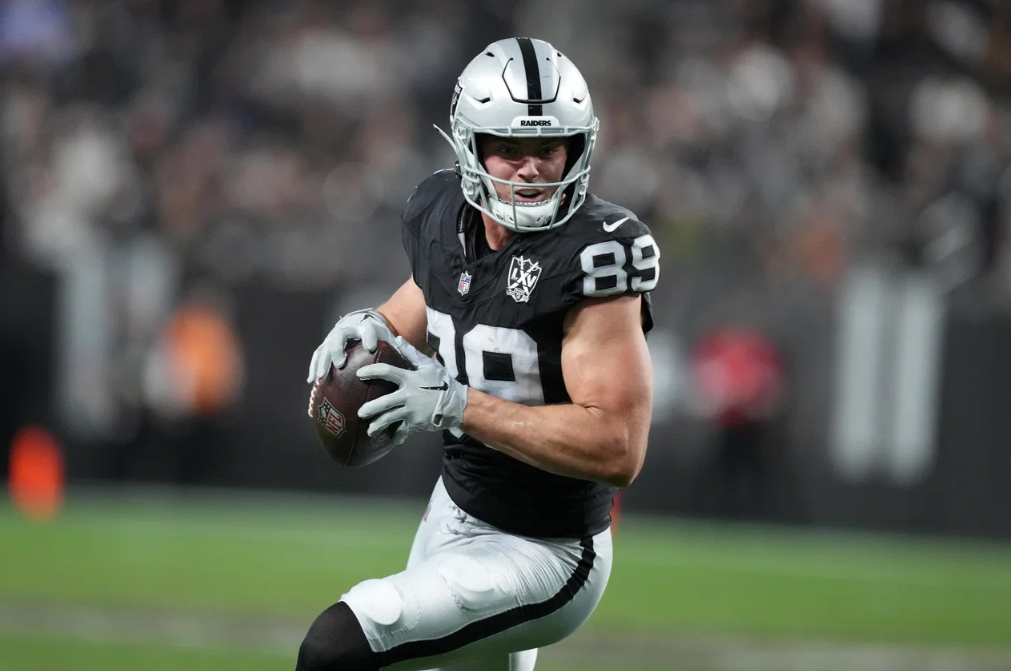
The tight end is one of the most versatile positions in American football, combining the physical demands of blocking with the skills of a pass catcher. Tight ends help create running lanes, protect the quarterback, and provide receiving options across the field. Their ability to handle different assignments makes them valuable in offenses that rely on both running and passing plays.
Depending on the offensive scheme, a tight end might line up beside an offensive tackle, move into the slot, or split out wide. These alignments allow teams to exploit defensive weaknesses without changing personnel. A versatile tight end can shift between blocking and receiving assignments without tipping off the defense.
What Is a Tight End in Football?
A tight end (TE) is an offensive player whose responsibilities include blocking defenders and catching passes. The tight end position requires enough strength to hold its own against defensive linemen, along with the speed, coordination, and reliable hands needed to beat coverage.
Under NFL numbering rules, tight ends may wear jersey numbers from 40–49 or 80–89. To catch a forward pass legally, they must also occupy an eligible position in the offensive formation.
The main tight end responsibilities include:
- Run blocking: Creating running lanes by controlling defensive ends, linebackers, and other defenders.
- Pass protection: Helping offensive tackles contain pass rushers and protect the quarterback.
- Receiving: Running routes to provide passing options underneath, downfield, or near the goal line.
- Pre-snap motion: Changing alignment to influence defensive positioning or help the quarterback identify coverage.
These tight end duties can vary considerably from one play to the next, depending on the formation and defensive front.
Where Does a Tight End Line Up?
Traditionally, a tight end lines up directly beside an offensive tackle, on either side of the offensive line. This is known as an inline alignment and is commonly associated with the Y tight end role. From this position, the player can block at the line of scrimmage, protect the quarterback, or release into a passing route.
Modern offenses use several other alignments to take advantage of a tight end’s size and mobility.
| Alignment | Position on the field | Typical purpose |
| Inline | Beside an offensive tackle | Run blocking, pass protection, and route releases |
| Slot | Between the offensive line and an outside receiver | Creating matchups against linebackers and safeties |
| Split wide | Detached from the offensive line, near the sideline | Attacking defensive backs in coverage |
| Wing | Slightly behind and outside an offensive tackle | Motion, blocking, and play-action concepts |
| Backfield | Behind the line of scrimmage | Lead blocking, pass protection, and passing routes |
Alignment also affects receiving eligibility. If another player lines up on the line of scrimmage outside an inline tight end, the tight end becomes covered and is no longer an eligible receiver under standard NFL formation rules.
This distinction matters because offenses must follow formation rules regardless of how many tight ends they use.
Main Responsibilities of a Tight End
A tight end’s assignment depends on the play call and defensive alignment. On running plays, the player may seal a defensive end inside, reach an outside defender, or climb to the second level to block a linebacker. Each assignment helps the running back find space while preventing defenders from getting into the backfield.
During passing plays, the tight end can stay in protection, release immediately into a route, or briefly engage a pass rusher before becoming a receiving option. The last technique, known as a chip release, helps slow the defender without removing the tight end from the passing play.
Tight ends are particularly useful in short-yardage and red-zone situations. Their size helps them compete for contested catches, while their blocking ability allows offenses to use heavier personnel without abandoning the passing game.
Blocking in Running and Passing Plays
Tight end blocking requires a player to establish leverage and control defenders at the point of attack. Different blocking techniques serve different purposes:
- Drive block: Moving a defender backward to create space for the ball carrier.
- Reach block: Gaining outside leverage on a defender, often during outside-zone runs.
- Down block: Blocking a defender toward the interior of the formation.
- Lead block: Moving ahead of the ball carrier to engage a defender in the running lane.
On outside runs, setting the edge can determine whether the running back turns the corner or gets stopped behind the line of scrimmage.
Pass protection calls for different footwork and timing. The tight end must recognize the rusher’s approach, maintain a stable base, and use proper hand placement to prevent a direct path to the quarterback. Some assignments involve full pass protection, while others require only a brief chip before releasing downfield.
Running Routes and Catching Passes
As receivers, tight ends frequently attack the middle of the field, where linebackers and safeties are responsible for coverage. Against zone defenses, they look for openings between defenders. Against man coverage, they can use their size and positioning to gain an advantage over smaller defensive backs.
Common tight end routes include:
- Seam: A vertical route attacking the space between coverage defenders.
- Stick: A short route in which the receiver turns or settles into an open area, often adjusting to the defender’s positioning.
- Out: A route that breaks toward the sideline.
- Corner: A route that breaks diagonally toward the outside and downfield.
- Crossing route: A route across the formation designed to create separation.
- Flat: A short route toward the sideline, often serving as a quick passing option.
Tight end receiving requires concentration and body control, particularly when defenders are closing in. Players must secure the ball through contact and transition quickly from the catch to gaining yards after reception.
Different Types of Tight Ends
Not every tight end has the same role. Coaches assign responsibilities according to a player’s strengths, and some offensive systems place greater emphasis on receiving ability than traditional inline blocking.
| Type | Primary strength | Typical usage |
| Blocking tight end | Strength and blocking technique | Run-oriented personnel packages and additional pass protection |
| Receiving tight end | Route running, speed, and catching | Passing downs, slot alignments, and red-zone targets |
| Balanced tight end | Effective blocking and receiving | Every-down offensive packages |
| Move tight end | Mobility and alignment flexibility | Pre-snap motion, detached alignments, and favorable matchups |
Blocking specialists often feature in heavier personnel groupings, while receiving tight ends may operate much like large slot receivers. Balanced players can remain on the field in a wider range of situations, from short-yardage runs to obvious passing downs.
Some offenses also use an H-back, a hybrid role that typically operates off the line of scrimmage, often from a wing alignment or the backfield. Depending on the play, an H-back may lead block, move across the formation, protect the quarterback, or run a passing route. The same player can perform both traditional tight end and H-back assignments.
Tight End vs Wide Receiver: Key Differences
Tight ends and wide receivers are both eligible pass catchers when properly aligned, but their typical assignments and physical demands differ.
| Feature | Tight end | Wide receiver |
| Primary role | Blocking and receiving | Primarily receiving |
| Typical alignment | Inline, slot, wing, or wide | Outside or slot |
| Blocking demands | Regular contact with defensive linemen and linebackers | Primarily perimeter and downfield blocking |
| Coverage matchups | Mainly linebackers and safeties, sometimes cornerbacks | Mainly cornerbacks and safeties |
| Blocking matchups | Defensive ends, linebackers, and other front-seven defenders | Cornerbacks, safeties, and perimeter defenders |
| Physical profile | Generally larger and heavier | Generally lighter and faster |
| Route usage | Short, intermediate, and vertical routes | Full route tree, with frequent emphasis on separation |
These differences are not absolute. Receiving tight ends can run complex routes and line up outside, while physical wide receivers contribute significantly to the running game through blocking.
The main distinction is the range of blocking assignments. A tight end may have to control a defensive end at the line of scrimmage on one snap and beat a safety downfield on the next. Wide receivers are rarely asked to handle that combination.
What Skills Does a Good Tight End Need?
Playing tight end requires more than size and catching ability. The player must execute technically demanding assignments while recognizing defensive adjustments before and after the snap.
Important tight end skills include:
- Strength and leverage: Maintaining position against larger defenders and controlling contact during blocks.
- Reliable hands: Catching passes outside the body frame and securing the ball through contact.
- Route-running technique: Using precise footwork, sharp breaks, and changes of pace to separate from defenders.
- Blocking fundamentals: Maintaining a strong base and applying effective hand placement.
- Defensive recognition: Identifying coverage, blitzes, and potential blocking assignments.
- Body control: Adjusting to high, low, or off-target passes.
- Acceleration and agility: Getting into routes quickly and creating separation against linebackers or safeties.
Communication is equally important. Tight ends often coordinate with offensive tackles when defensive fronts shift or opponents threaten a blitz. A missed adjustment can leave a pass rusher unblocked or disrupt the timing of a running play.
How to Train for the Tight End Position
Tight end training should reflect the demands of actual games. Weight-room strength provides a foundation, but players also need controlled footwork, explosive movement, sound blocking technique, and dependable receiving skills.
An effective training program combines position-specific drills with strength development and film study. Players should also practice transitioning between assignments, particularly when a play requires them to sell a block before releasing into a passing route.
Blocking and Footwork Drills
Blocking practice begins with stance, first-step quickness, and maintaining balance through contact. Players need to generate force through their legs while keeping their feet underneath them.
Useful exercises include:
- Sled drives: Developing leg drive and sustained blocking pressure.
- Mirror drills: Improving lateral movement and balance against a moving defender.
- Reach-block drills: Practicing the footwork needed to secure outside positioning.
- Fit-and-drive drills: Establishing proper hand placement and maintaining contact through the block.
- Pass-protection sets: Working on controlled steps, hand timing, and recognizing pass-rush moves.
Coaches should focus on positioning and execution rather than simply rewarding hard contact. A blocker who maintains balance and wins the leverage battle is more effective than one who relies on strength alone.
Route Running and Catching Drills
Receiving practice should prepare tight ends for contested catches, tight coverage, and quick changes of direction.
During training, players can work on releases against simulated contact, short-area cuts, seam routes, and catching passes while turning upfield. Drills should include high and low throws, catches over either shoulder, and securing the ball before contact.
Two useful exercises are:
- Option-route drills: Teaching players to adjust their routes according to a defender’s leverage and coverage.
- Traffic-catching drills: Improving concentration and ball security when defenders are nearby.
Film study complements these exercises. Reviewing linebacker drops, safety rotations, and defensive coverage helps players anticipate where passing lanes will open during a play.
Common Mistakes Young Tight Ends Should Avoid
Young tight ends sometimes focus heavily on catching passes while overlooking the technical details that determine whether they can contribute on every down.
One common mistake is blocking from an upright stance. High pad level allows defenders to gain leverage and disrupt the play. Reaching with the arms instead of moving the feet creates another problem, leaving the blocker off balance and vulnerable to being beaten.
In the passing game, inexperienced players may round off their routes, making breaks easier for defenders to anticipate. Turning toward the quarterback too early can also slow a route and reduce separation.
Alignment errors carry additional consequences. A tight end who lines up incorrectly may become an ineligible receiver or contribute to an illegal formation. Misreading a blitz can also result in a missed protection assignment, leaving the quarterback exposed to an unblocked defender.
Young players benefit from correcting these mistakes through focused practice. Consistently executing assignments, recognizing defensive adjustments, and understanding the playbook are essential steps toward becoming a dependable tight end.
FAQ
What does tight end mean in football?
The tight end meaning comes from the player’s traditional position at the end of the offensive line, directly beside an offensive tackle. In American football, a tight end combines blocking responsibilities with the ability to catch forward passes.
Can a tight end catch a pass?
Yes. A tight end can catch a forward pass when properly positioned as an eligible receiver. In the NFL, formation and jersey-number rules apply. Players wearing normally ineligible numbers must report to the referee when lining up in an eligible position, and reporting does not override formation requirements.
Is a tight end an offensive lineman?
No. Although tight ends regularly block alongside offensive linemen, they are considered a separate offensive position. Unlike regular offensive linemen, they can serve as eligible receivers.
How many tight ends can play at once?
An offense can use multiple tight ends in the same formation. A two-tight-end package is called 12 personnel, meaning one running back and two tight ends. A package with one running back and three tight ends is known as 13 personnel. All formations must comply with the applicable alignment and eligibility rules.
What is the difference between a tight end and an H-back?
A traditional tight end commonly lines up beside an offensive tackle, while an H-back generally operates off the line of scrimmage. H-backs are frequently used for motion, lead blocking, pass protection, and receiving assignments. The roles overlap, and one player may handle both.
Why are tight ends important in modern football?
Tight ends can force defenses into difficult personnel decisions. A defense that uses heavier players to stop the run may struggle to cover an athletic tight end, while a smaller defensive package can be vulnerable to physical blocking. Offenses use these matchups to attack different areas of the field and make defensive adjustments more difficult.