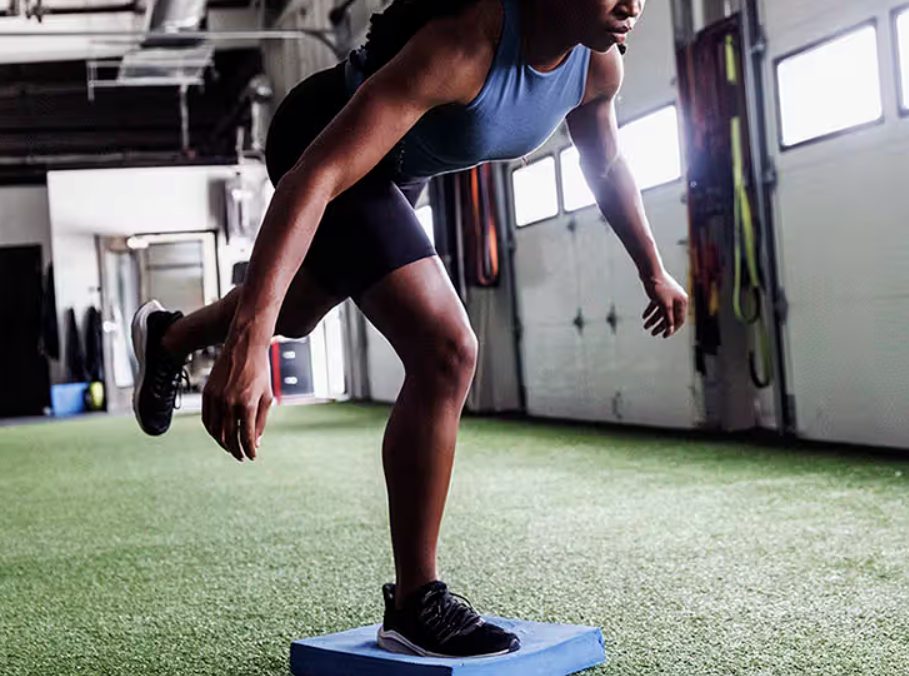
Every time a basketball player lands after a rebound, a runner adjusts their stride on uneven ground, or a gymnast completes a rotation, the body makes small adjustments without conscious effort. Much of this control depends on proprioception, the sensory system that helps the brain track the position and movement of different body parts.
For athletes, proprioception contributes to joint control, coordination, and the ability to react to unexpected changes in movement. Understanding how it works can help athletes choose appropriate balance exercises, coordination drills, and sport-specific training methods.
What Is Proprioception?
A simple proprioception definition is the body’s ability to sense the position and movement of its limbs, along with muscular effort, without relying on vision.
Close your eyes and bend your elbow. Even without looking, you can tell approximately where your hand is. You can also adjust your grip on an object without watching your fingers. Both actions rely partly on proprioceptive feedback.
The proprioception meaning becomes clearer when compared with other senses. Vision tells us about the surrounding environment, while hearing detects sound. Proprioception provides information about joint angles, muscle length, movement direction, and muscular tension.
This form of body awareness helps with everyday tasks such as climbing stairs, reaching for objects, and maintaining posture. In sports, it becomes particularly valuable when movements are fast, complex, or performed under changing conditions.
Proprioception is sometimes called the sixth sense, although it involves several related sensory functions rather than a single sensory organ.
How Does Proprioception Work?
The proprioceptive system relies on specialized receptors found mainly in muscles, tendons, and tissues surrounding joints. These receptors detect mechanical changes and send information through sensory nerves to the central nervous system.
Three important sources of proprioceptive information are:
- Muscle spindles: Located within skeletal muscles, they detect muscle length and how quickly it changes. They help the nervous system monitor movement and contribute to stretch reflexes.
- Golgi tendon organs: Found near muscle-tendon junctions, these receptors respond to tension and provide feedback involved in regulating muscular force.
- Joint and other mechanoreceptors: Receptors in joint capsules, ligaments, and surrounding tissues detect mechanical loading and changes in tissue deformation. Some contribute particularly strongly near the limits of joint movement.
The nervous system combines these signals with visual information and input from the vestibular system, which detects head movement and orientation relative to gravity.
Some responses travel through rapid spinal pathways, while others involve the brainstem, cerebellum, and cerebral cortex. Together, these processes allow the body to monitor movement and adjust muscular activity without requiring conscious attention to every joint.
Examples of Proprioception in Everyday Life and Sports
Proprioception helps people button a shirt without watching every finger movement or walk through a dark room while remaining aware of their limb positions.
A football player uses body-position awareness to control a pass while watching the ball and nearby opponents. A tennis player coordinates arm movement and racket position throughout a stroke. During a snatch, a weightlifter relies on proprioceptive feedback to stabilize the barbell overhead.
Other proprioception examples include a skier adjusting leg position on changing terrain, a volleyball player controlling their landing after a block, and a sprinter monitoring limb position during rapid ground contacts.
These actions also depend on vision, strength, motor skills, and anticipation. Proprioception provides sensory feedback that supports these other abilities rather than replacing them.
Why Is Proprioception Important for Athletes?
Athletes regularly jump, accelerate, change direction, and perform movements that place considerable demands on their joints and muscles.
Proprioceptive feedback helps them monitor limb position and respond when movement differs from what they expected. This becomes especially important during awkward landings, sudden changes of direction, physical contact, or movements performed without a clear view of the limbs.
Balance and Body Control
Balance depends on proprioceptive, visual, and vestibular information working together. The nervous system uses these inputs to maintain or regain postural stability, whether an athlete is standing still or moving.
During a single-leg landing, proprioceptive awareness helps the athlete detect changes in ankle, knee, and hip position. The muscles respond to control joint movement and stabilize the landing.
Good balance also requires sufficient strength, mobility, and timely muscle activation. An athlete may perform well in a controlled balance exercise yet struggle when landing at speed or reacting to an opponent.
Balance training can improve stability and control during specific tasks, although better performance does not necessarily mean that proprioceptive sensitivity itself has increased.
Coordination and Movement Accuracy
Proprioception contributes to the timing and accuracy of complex movements involving several joints.
A baseball pitcher coordinates movement through the legs, trunk, shoulder, elbow, and wrist to deliver the ball. A swimmer must synchronize arm and leg actions while maintaining an efficient position in the water.
In both sports, sensory feedback helps monitor movement as it unfolds. Motor planning and repeated practice are equally important, allowing experienced athletes to perform familiar actions without consciously controlling every joint.
Feedback becomes particularly useful when something interrupts the expected movement, such as contact with another player or an unexpected change in footing.
Proprioception vs Balance vs Kinesthesia
These terms are related but do not mean exactly the same thing.
| Term | Meaning | Sporting example |
| Proprioception | Awareness of body position, movement, and muscular effort | Sensing knee position during a squat without looking down |
| Balance | The ability to maintain or regain postural stability | Staying upright after landing on one leg |
| Kinesthesia | The perception of body movement, including its direction and speed | Feeling the arm move through a tennis serve |
Kinesthesia is generally considered part of proprioception, specifically the perception of movement.
Balance is a broader motor-control ability that relies on several sensory systems, muscular responses, and mechanical factors. Someone may have accurate joint-position awareness but still struggle to balance because of fatigue, weakness, or the difficulty of the task.
How to Test Proprioception
There are several ways to assess proprioception, but no single test measures every aspect of it.
Clinical and research assessments typically examine joint position sense, movement detection, or the ability to reproduce a specific muscular force.
One common method is the joint position matching test. An examiner places a joint at a target angle, and the participant attempts to reproduce that position without looking. The difference between the target and reproduced angles is called the joint position matching error. It reflects the accuracy of both position perception and reproduction.
Another method measures the threshold to detection of passive movement. An examiner or specialized device slowly moves a joint while the participant indicates when they first detect movement.
Force reproduction tests assess how accurately someone can reproduce a previously experienced muscular effort, usually against a measured resistance.
Coaches and therapists may also use practical field assessments to examine related movement-control abilities:
- Single-leg stance: Standing on one leg with eyes open and, when safe, eyes closed to assess postural stability under different sensory conditions.
- Single-leg landing: Observing knee alignment, trunk control, and the ability to stabilize after landing.
- Star Excursion Balance Test: Reaching in multiple directions with one foot while maintaining support on the other leg to assess dynamic balance.
Unlike joint-position or movement-detection tests, these field assessments do not isolate proprioceptive sensitivity. Their results also depend on strength, mobility, coordination, fatigue, and previous injuries.
Best Proprioception Exercises for Athletes
Proprioception exercises are commonly included in neuromuscular training programs that develop balance, coordination, and joint control.
Exercises should match the athlete’s experience and sporting demands. Beginners can start with controlled single-leg movements, while more experienced athletes may progress to landing drills, changes of direction, and exercises requiring rapid reactions.
Single-Leg Balance Exercises
Single-leg balance is a practical starting point because it challenges postural stability without requiring specialized equipment.
To perform a basic single-leg stance:
- Stand upright with your feet hip-width apart.
- Shift your weight onto one leg and lift the other foot slightly off the floor.
- Keep the supporting knee slightly bent and your pelvis level.
- Hold the position for 20–30 seconds without excessive trunk movement.
- Repeat on the opposite leg for two or three sets.
Once you can maintain the position comfortably, add slow head turns, reaching movements, or controlled upper-body tasks.
Closing your eyes removes visual input and increases reliance on proprioceptive and vestibular information. Beginners should attempt this variation near a stable support.
Single-leg exercises are useful for sports involving frequent weight transfer or unilateral support, including running, football, basketball, and tennis. They provide a foundation for more demanding movements but cannot replace dynamic training.
Dynamic Balance and Coordination Drills
Dynamic exercises challenge athletes to maintain control while their body position, joint angles, and center of mass change.
Useful drills include:
Single-leg Romanian deadlift: Stand on one leg, hinge at the hips, and extend the opposite leg backward. Keep the spine neutral and pelvis level before returning upright. The movement develops single-leg strength, balance, and hip control. Multidirectional reaches: Balance on one leg while reaching the other foot forward, sideways, and diagonally. The supporting leg controls the movement as body weight shifts. Lateral bounds: Jump sideways from one leg to the other, land softly, and briefly hold the position. Start with short distances before progressing to longer jumps. Step-downs: Stand on a low step and slowly lower the opposite heel toward the floor. Keep the supporting knee aligned with the foot and avoid uncontrolled pelvic movement. Partner perturbations: Maintain an athletic stance while a partner applies gentle, controlled pushes to the shoulders or trunk. Introduce less predictable disturbances once the athlete can respond safely.
These drills develop different combinations of strength, coordination, balance, and reactive control. Begin with deliberate movements and increase speed or difficulty only when technique remains consistent.
Sport-Specific Proprioception Training
Sport-specific exercises should reflect the movements and conditions athletes encounter during competition.
Football players can practice receiving and passing the ball while balancing on one leg, then progress to changes of direction. Basketball players benefit from jump landings, lateral movement, and deceleration drills following short sprints.
Tennis players can practice split steps, multidirectional footwork, and reaching movements that reproduce court positioning. Runners may incorporate single-leg strength exercises, hopping progressions, and running drills. Gymnasts can use controlled landings and body-position exercises suited to their technical level.
A useful progression begins with predictable movements and gradually introduces external cues.
For example, an athlete might first practice a planned lateral cut before repeating the movement in response to a coach’s visual signal. The second drill adds reaction and decision-making demands, making it more representative of competitive play.
These exercises should complement strength training and technical practice. Balance and reaction drills cannot compensate for insufficient strength or poor movement technique.
How to Include Proprioception Training in Sports Practice
Proprioception-related exercises can fit into warm-ups, strength sessions, or rehabilitation programs without requiring a separate workout.
For healthy athletes, 10–15 minutes two or three times per week is a practical starting point. A short session might combine single-leg balance, step-downs, lateral bounds, and controlled landings. The appropriate workload depends on training experience, sporting demands, and recovery needs.
Difficulty can be increased through movement speed, range of motion, resistance, or less predictable tasks. Progress should reflect the athlete’s ability to maintain control rather than simply completing more repetitions.
Unstable surfaces can increase balance demands, but they are not automatically better than firm ground. Heavy lifting, explosive jumps, and high-speed cutting generally require stable footing to maintain force production and proper technique.
Movement quality matters as much as exercise selection. Repeatedly practicing poorly controlled landings, particularly under excessive fatigue, may reinforce ineffective movement patterns.
Neuromuscular training also has an important role in injury rehabilitation and prevention. Structured balance programs can help reduce recurrent ankle sprains, while broader programs combining strength, coordination, and movement training may help address other injury risks.
These benefits arise from several adaptations rather than proprioception alone. Athletes recovering from joint injuries should follow an individualized program developed with a qualified healthcare professional.
FAQ
Can proprioception be improved through training?
Yes. Joint-position exercises, balance training, strength work, and sport-specific drills can improve aspects of proprioceptive performance and sensorimotor control. Results depend on the exercises used and the abilities being measured. Improvements in balance do not necessarily indicate equal improvements in every component of proprioception.
What causes poor proprioception?
Joint injuries, damage to peripheral nerves, and certain neurological conditions can impair position and movement sense. Fatigue may temporarily affect sensorimotor performance. However, difficulty maintaining balance does not automatically indicate a proprioceptive deficit.
Is proprioception important for injury prevention?
Proprioception contributes to joint control, making it relevant to injury-prevention training. Balance and neuromuscular exercise programs are particularly useful for reducing recurrent ankle sprains. Injury risk also depends on strength, movement mechanics, fatigue, previous injuries, and exposure to sporting demands.
How often should athletes do proprioception exercises?
Two or three short sessions per week are a reasonable starting point for general training. Some drills can be included in regular warm-ups. Frequency and intensity should reflect the athlete’s goals, current abilities, and training workload. Rehabilitation may require a different schedule.
What is the difference between proprioception and muscle memory?
Proprioception provides sensory information about body position, movement, and muscular effort. Muscle memory is an informal term for motor skills that become more automatic through repetition. Practice helps the nervous system organize familiar movements efficiently, while proprioceptive feedback continues to support their execution.