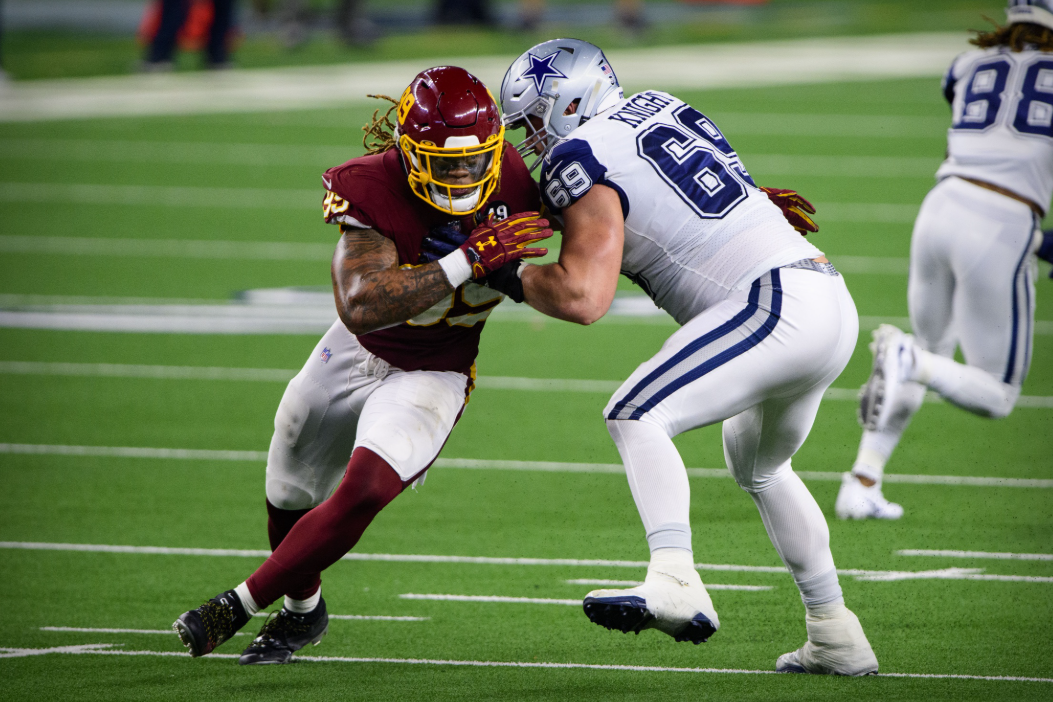
A defensive end is a defensive lineman who plays near the outside of the defensive front. Defensive ends help stop the run, pressure the quarterback, and keep ball carriers from getting around the edge. Their assignments vary by defensive scheme. Some primarily rush the passer, while others spend more time engaging blockers and controlling gaps along the line of scrimmage.
The defensive end position demands strength, explosiveness, sound technique, and quick reactions. Players must read the offensive line, recognize blocking schemes, and know when to attack or hold their ground. Sacks get the headlines, but setting the edge, disrupting blocks, and forcing hurried throws can be just as valuable.
What Is a Defensive End in Football?
In American football, a defensive end (DE) lines up at or near the end of the defensive line. Defensive ends commonly align over or outside offensive tackles, although their starting position depends on the defensive front and offensive formation.
Their job is to disrupt plays at or near the line of scrimmage. Against the run, they close rushing lanes and prevent ball carriers from reaching open space outside. On passing downs, they try to beat blockers and reach the quarterback before a throw develops.
The defensive end role changes considerably between systems. In a traditional 4–3 defense, defensive ends line up outside the defensive tackles and often serve as the primary edge rushers. In a traditional 3–4 front, they typically align over or near offensive tackles and may be assigned one-gap penetration or two-gap control. Outside linebackers frequently handle the outside pass rush in those formations.
Modern NFL defenses mix personnel and fronts throughout a game. As a result, the distinction between a defensive end and an outside linebacker often comes down to the player’s assignment rather than the position listed on the roster.
Where Does a Defensive End Line Up?
A defensive end’s alignment determines which blocker they are likely to face, the angle available to attack the backfield, and the gaps they must defend. Coaches use numbered techniques to describe a defender’s position relative to offensive linemen.
Common defensive end alignments include:
- 4-technique: Directly across from an offensive tackle, particularly in three-man defensive fronts.
- 5-technique: On the outside shoulder of an offensive tackle, a common position for defensive ends in several fronts.
- 6-technique: Head-up over an attached tight end.
- 7-technique: On the inside shoulder of an attached tight end.
- 9-technique: Outside an attached tight end. A wide-9 alignment places the defender well outside the offensive tackle, creating space for an outside pass rush even when no tight end is present.
A defensive end in a wide alignment has more room to build speed and attack the tackle’s outside shoulder. The trade-off is a longer route to the quarterback and greater exposure to inside runs if the defender fails to maintain the assigned gap.
Closer alignments offer different advantages. A 4-technique defender may be asked to control the offensive tackle and read the play, while a 5-technique defender can attack the outside shoulder or work into an assigned gap.
Main Responsibilities of a Defensive End
Defensive end responsibilities depend on the offensive formation, down and distance, and defensive play call. The two central defensive end duties are stopping running plays and pressuring the quarterback, but both require coordination with the rest of the front.
A defender who beats an offensive tackle but leaves a running lane open may actually help the offense. Understanding the assignment matters as much as winning the individual matchup.
Rushing the Quarterback
On passing plays, defensive ends try to defeat offensive tackles, tight ends, or additional pass protectors and disrupt the passing play.
A sack is the most obvious result, but pass rushing produces other valuable outcomes. A defender can force the quarterback to move away from the intended throwing spot, hurry a pass, or abandon a developing route. Consistent pressure also makes it harder for an offense to execute longer-developing passing concepts.
An effective defensive end pass rush depends on several fundamentals:
- Get-off: Reacting to the snap and accelerating before the blocker establishes position.
- Pad level: Staying low enough to generate leverage through contact.
- Hand technique: Using strikes, swipes, and counters to prevent blockers from controlling the rush.
- Rush angle: Taking an efficient path toward the quarterback without running too far upfield.
- Pocket awareness: Adjusting the rush to the quarterback’s depth and movement.
- Rush-lane integrity: Working with teammates to prevent easy escape routes.
Quarterback contain becomes especially important against mobile passers. An edge defender who rushes too far inside may leave an open path toward the sideline. Even when a defender cannot reach the quarterback, maintaining outside leverage can prevent a scramble and force the passer to remain in a collapsing pocket.
Defensive ends must also account for chip blocks from running backs and tight ends. These brief contacts can interrupt the initial rush and give an offensive tackle time to recover.
Defending Against Running Plays
Run defense begins with reading the initial movement of offensive linemen. A defensive end must recognize the blocking action, protect the assigned gap, and react to the ball carrier’s path.
Against outside runs, a defensive end may be responsible for setting the edge. This involves keeping the ball carrier from reaching the sideline and directing the play back toward pursuing teammates.
Other assignments call for penetration into a specific gap or squeezing a running lane by driving the offensive tackle inward. Some defenses use a force defender to turn the runner inside, while others use spill techniques to redirect the ball carrier toward an outside teammate. The correct response depends on the team’s run-fit rules and the location of supporting defenders.
Recognizing common blocking techniques is essential. A reach block attempts to gain leverage across the defender’s body, while a down block may signal a gap-running concept that requires a specific response from the defensive front.
Defensive ends also help keep offensive linemen from reaching linebackers at the second level. By occupying or disrupting an offensive tackle, a defender can leave a teammate free to pursue the ball.
Defensive End Techniques and Playing Styles
Defensive end techniques vary according to a player’s build, alignment, and assignments. Speed-oriented rushers try to beat offensive tackles around the corner, while power rushers use leverage and force to push blockers into the pocket.
A player who can threaten both the outside shoulder and the inside gap presents a much tougher challenge. Offensive tackles must adjust their positioning without knowing which attack is coming next.
Defensive End Stances and Alignments
A defensive end stance affects balance, first-step acceleration, and the ability to react to offensive movement.
Two stances are especially common:
- Three-point stance: The defender places one hand on the ground, usually with their weight positioned for a quick, powerful first step. Defensive linemen often use it when preparing to engage blockers immediately.
- Two-point stance: The defender starts upright with both hands free. This is common among stand-up edge rushers who need a clearer view of the formation or may have coverage responsibilities.
Neither stance is universally better. A player may use both during the same game, depending on the defensive package and expected assignment.
The two-point stance gives a defender more freedom to read backfield movement before engaging. A three-point stance can help a lineman generate immediate forward momentum, particularly when attacking a blocker directly. In either case, the first step must match the intended rush angle or run-defense responsibility.
Common Pass-Rushing Moves
Defensive ends use a combination of speed, power, and hand techniques to beat pass protection. Each move creates a different problem for the offensive tackle.
| Technique | How It Works | Typical Purpose |
| Speed rush | Accelerates toward the outside shoulder and bends around the tackle | Reach the quarterback around the edge |
| Bull rush | Drives through the blocker with leverage and leg power | Push the tackle back into the pocket |
| Rip move | Drives an arm upward through the blocker’s contact | Clear the blocker’s hands and turn toward the quarterback |
| Swim move | Brings an arm over the blocker’s shoulder | Slip past a blocker leaning too far forward |
| Spin move | Rotates away from contact to change direction | Counter a blocker who overcommits |
| Speed-to-power | Threatens the outside rush, forces the tackle to retreat, then converts momentum into a powerful drive | Collapse the pocket against a blocker protecting the edge |
The best move depends on the tackle’s positioning. If a blocker repeatedly widens to stop an outside rush, the defender may attack inside with a counter move. If the tackle retreats too quickly to protect the corner, a speed-to-power rush can take advantage of their backward momentum.
Hand placement and timing are crucial. A poorly executed move can leave the defender off balance or allow the offensive tackle to regain control.
Pass rushers also use combinations rather than isolated techniques. An outside rush early in the game may set up an inside counter later, particularly once the tackle begins anticipating the defender’s initial movement.
Defensive End vs Linebacker vs Defensive Tackle
These positions share some responsibilities, but their usual alignments and assignments differ.
| Position | Typical Alignment | Primary Responsibilities |
| Defensive end | At or near the outside of the defensive line | Pass rushing, run defense, edge containment, block disruption |
| Defensive tackle | Interior defensive line | Interior gap control, run stopping, inside pass rush |
| Linebacker | Behind the defensive line or on the edge | Run fits, tackling, pass coverage, blitzing |
Defensive tackles generally face guards and centers in congested areas of the line. They must withstand combination blocks, maintain leverage, and prevent runs through interior gaps.
Linebackers handle a wider range of assignments. Depending on the play, they may fill a running lane, pursue a ball carrier, cover a receiver, or blitz the quarterback.
Some outside linebackers are primarily edge rushers and perform many of the same tasks as defensive ends. Hybrid defenders can rush from a two-point stance on one down and drop into coverage on another. The defensive scheme determines how these players are used.
What Skills Make a Good Defensive End?
The most important defensive end skills combine physical ability with an understanding of offensive tendencies. A wide edge rusher may prioritize acceleration and flexibility, while a defensive end in a three-man front often needs more strength to handle offensive tackles and combination blocks.
Several qualities are particularly important:
- Explosiveness: Producing a fast first step and challenging the blocker immediately after the snap.
- Functional strength: Absorbing contact, controlling leverage, and holding position against the run.
- Agility: Redirecting quickly without losing balance or taking inefficient pursuit angles.
- Hand technique: Preventing offensive linemen from locking onto the defender’s chest and controlling the engagement.
- Play recognition: Identifying run and pass indicators, blocking patterns, and potential misdirection.
- Discipline: Following assignments even when an opportunity to chase the ball appears elsewhere.
Flexibility is another advantage, especially for pass rushers who need to bend around the outside of an offensive tackle while keeping their feet moving.
Film study helps turn these abilities into consistent performance. By watching how offensive tackles set their feet, position their hands, and react to different rushes, defensive ends can identify weaknesses and choose better counters.
How to Train for the Defensive End Position
Defensive end training should develop the strength, acceleration, movement skills, and technical control needed for run defense and pass rushing.
A beginner learning basic leverage needs a different program from an experienced college player preparing for advanced blocking schemes. Training intensity and contact work should match the player’s age, experience, and physical development.
Strength, Speed, and Agility Training
Strength work helps defensive ends withstand blocks and generate force through contact. Squats, deadlift variations, lunges, presses, and pulling exercises can develop the lower-body and upper-body strength required for the position.
Proper technique and progressive loading matter more than lifting the heaviest possible weight. Players must be able to apply strength while moving and maintaining balance.
Speed training should emphasize short acceleration efforts. Defensive ends rarely need to sprint long distances during a play, but they repeatedly accelerate over the first few yards. Short sprints and resisted starts can help improve this ability.
Agility training should include lateral movement, changes of direction, and controlled hip rotation. These movements are useful when reacting to a running back cutting inside or a quarterback escaping the pocket.
Conditioning should help players maintain their technique throughout a drive. Repeated short bursts of effort, followed by appropriate recovery, better reflect the demands of the position than steady-paced distance running alone.
Footwork and Pass-Rushing Drills
Defensive end drills help players put their technique to work against realistic blocking looks.
Useful exercises include:
- Get-off drills: Reacting to ball movement rather than the quarterback’s voice and accelerating into the first steps.
- Hand-fighting drills: Practicing strikes, swipes, and disengagement against controlled resistance.
- Hoop drills: Learning to bend around a tight turning path without drifting too far upfield.
- Block recognition drills: Identifying reach blocks, down blocks, and different pass protection sets.
- Pursuit-angle drills: Taking efficient routes toward moving ball carriers.
- Run-fit drills: Practicing assigned gaps and edge responsibilities within the defensive front.
Players can begin with individual movements before progressing to one-on-one work against offensive tackles. Controlled repetitions allow coaches to correct foot placement, leverage, and hand timing before increasing the speed of the drill.
Practice footage is particularly useful for spotting mistakes that are difficult to notice during a rep. Reviewing the first two steps, contact position, and response to blocking movement helps players understand what needs improvement.
Common Mistakes Young Defensive Ends Should Avoid
Young defensive ends often become too focused on reaching the backfield. Aggression is valuable, but it must fit the defensive assignment.
One common mistake is rushing past the quarterback. A defender may beat the offensive tackle around the outside but continue too far upfield, leaving an opening for the quarterback to step forward or escape underneath.
Another is standing upright immediately after the snap. Poor pad level gives offensive linemen easier access to the defender’s chest and makes it harder to generate power.
Other frequent errors include:
- Losing gap discipline: Chasing a ball carrier across the formation and leaving a running lane unprotected.
- Relying on one pass-rush move: Allowing offensive tackles to anticipate the same attack.
- Poor hand placement: Letting blockers establish control before attempting to disengage.
- Reacting to hard counts: Moving before the snap or giving away the intended rush.
- Misreading option plays: Attacking the running back without accounting for the quarterback keeping the ball.
- Ignoring misdirection: Pursuing initial backfield movement without recognizing a reverse, bootleg, or cutback.
Trying to make every tackle can also hurt the defense. A defensive end who forces a running back inside may have done the job correctly even if a linebacker finishes the play.
Young players improve by learning how their assignments fit together with those of their teammates. Better recognition, controlled movement, and reliable technique lead to more consistent results than chasing occasional highlight plays.
FAQ
What does a defensive end do in football?
A defensive end stops running plays, pressures the quarterback, and disrupts offensive blocking. Depending on the scheme, the player may rush from the edge, control an assigned gap, or occupy blockers to free teammates.
Is a defensive end the same as an edge rusher?
Not exactly. Defensive end is a position designation, while edge rusher describes a role. Edge rushers can be defensive ends or outside linebackers, depending on the team’s formation and personnel.
What is the difference between a 4–3 and a 3–4 defensive end?
In a traditional 4–3 defense, defensive ends usually align outside the defensive tackles and frequently rush from the edge. In a traditional 3–4 front, defensive ends tend to play closer to offensive tackles and may handle one-gap or two-gap assignments. Modern defenses often combine elements of both systems.
What physical attributes are important for a defensive end?
Explosive acceleration, functional strength, balance, agility, and flexibility are important. Wide edge rushers often benefit from speed and the ability to bend around blockers, while larger defensive ends need strength and leverage to control offensive linemen.
How can a beginner improve as a defensive end?
Beginners should master their stance, first step, pad level, hand placement, and gap assignments. Basic pass-rush moves, block recognition drills, and film review can help build reliable technique before progressing to more advanced skills.